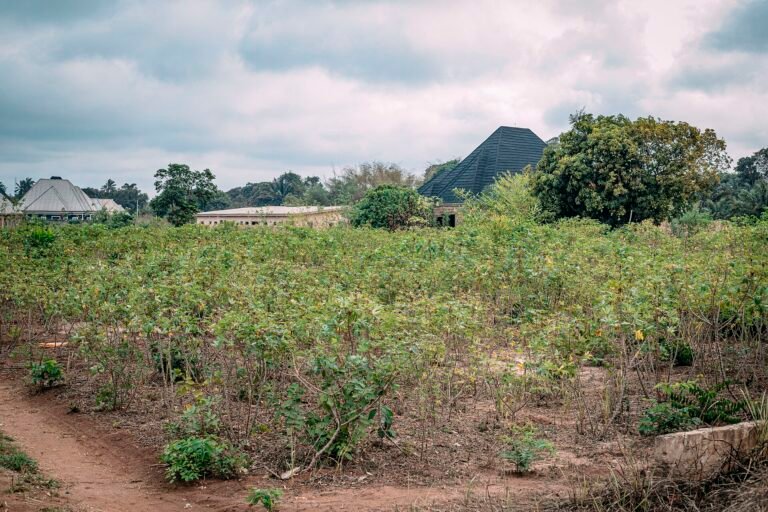
If you are buying land anywhere outside the planned parts of Nigeria’s big cities, there is a strong chance you are buying family land. Not government land, not company land, not land from an individual who bought it last year. Land that has belonged to a family for generations, that was farmed by people whose names are still remembered, and that is now being sold by their descendants. This is completely normal and entirely legitimate. Customary land ownership is recognised in Nigerian law, and family land has been bought and sold lawfully for as long as anyone can remember. Some of the safest property in the country sits on land that came from a family sale done properly.
The difficulty is that a family is not a person. When you buy from a company, one board resolution binds the company. When you buy from an individual, one signature binds the individual. When you buy from a family, you are dealing with a group whose membership is defined by descent, whose internal arrangements may never have been written down, and some of whose members may be in Lagos, in Abuja or overseas and entirely unaware that a sale is being discussed. Get the consent right and family land is solid. Get it wrong and you have bought a lawsuit with a beautiful view.
This guide explains how family land actually works, who has authority to sell, what a deed of partition is and why it changes everything, what documents to insist on, and how to test whether the family in front of you is united. Read it alongside our complete guide to buying land in Nigeria.
How family land is held
Under customary law across much of southern Nigeria, land acquired by a founding ancestor passes to their descendants collectively. It is not divided automatically. It is held by the family as a unit.
Three roles matter.
The family head. Usually the most senior surviving male of the founding line, though the exact rule varies by community. The family head manages the land on behalf of everyone.
The principal members. The senior representatives of each branch of the family. They are the people whose agreement, together with the family head’s, constitutes the family’s decision.
Other members. Everyone else with a share in the family land by descent.
The general position under customary law is that a sale of family land requires the family head acting together with the principal members. A sale by the family head alone, without the principal members, is generally voidable at the instance of the family. A sale by principal members without the family head is generally treated as void. And a sale by one member acting alone conveys nothing.
That is the legal foundation of the whole subject, and it explains the single most important practical instruction in this article: get the family head and the principal members to sign, and get their agreement recorded.
The deed of partition, and why it matters so much
Many families eventually decide to divide their land, so that each branch holds a defined portion in its own right rather than everyone holding everything jointly.
A deed of partition is the document that records that division. It identifies the family, the land, the branches, and which specific portion goes to which branch, and it should attach a survey plan showing the shares.
Once a partition has been properly made and documented, a branch can sell its own portion without needing the whole extended family to agree, because that portion is no longer held jointly. This dramatically simplifies your purchase and dramatically reduces the risk that a distant relative appears later with a claim.
So the first question to ask when offered family land is: has this land been partitioned, and can I see the deed of partition?
- If yes: confirm which branch the seller belongs to, confirm the portion matches the plot being sold, and get the branch’s head and principal members to sign.
- If no: you are dealing with jointly held family land, and you need the family head plus principal members of the whole family, with a written resolution.
The documents to insist on
- The deed of partition, where one exists, with its survey plan.
- A family resolution authorising the sale, dated, listing those present, describing the land and the price, and signed by the family head and named principal members.
- A deed of assignment naming the family head and principal members as vendors on behalf of the family, executed by all of them with witnesses, and attaching the survey plan. See deed of assignment explained.
- A registered survey plan with beacon numbers, lodged with the Surveyor-General. See survey plan explained.
- Evidence of the family’s root of title, whether inheritance from a named ancestor, a prior court judgment, a customary grant or an earlier purchase.
- Community or town union acknowledgement, where local practice expects it, properly minuted rather than promised.
- Receipts on letterhead, plot number stated, for every payment.
- Identification for the family head and principal members, matching the names on the documents.
Where the family land already has a state title, you also need a search and, on transfer, Governor’s Consent.
How to test whether the family is actually united
Documents can be produced. Unity is harder to fake, and there are practical ways to test it.
Ask three neighbours separately who the family head is. Do this on different days if you can, and do not let the seller accompany you. Three different answers means a contested family.
Ask who is not here. Enquire directly whether any principal member is abroad, unwell, estranged or opposed. Ask the question plainly and watch how it is received.
Ask for the signing to happen together. A sale where all the vendors sit in the same room, sign in front of the same witnesses, on the same day, is a very different thing from a document circulated for signatures over three weeks.
Ask about court cases. Directly. “Has this land ever been the subject of a dispute or a court case?” If yes, get the suit number and have your lawyer check the outcome. In parts of the South East and South West, dormant litigation over family land is common enough that this question earns its keep every time.
Look for a caveat in the search results at the registry. A caveat is somebody formally announcing a claim.
Watch the family’s own behaviour. If members interrupt each other, if one person insists on receiving all the money personally, if somebody is described dismissively as “the one causing trouble”, you have found your problem before it found you.
Payment, in a family sale
Family sales are where people revert to cash, and that is exactly where it is most dangerous.
- Pay by bank transfer. If there is one family account, use it. If payment must be split among branches, insist that the split is stated in the resolution and that each recipient issues a receipt for their portion.
- Never pay one member “for onward distribution” unless the resolution expressly says so and the other members have acknowledged it in writing.
- Get receipts from everyone who receives money.
- Stage the payment. A deposit on signing the contract, the balance on execution of the deed and handover of documents. This keeps the family engaged until the paperwork is finished.
- Budget for the customary items openly. Many communities have legitimate, established expectations around a sale, whether a presentation to the town union, a payment to the family for drinks, or a development levy. These are not scams when they are normal, documented and receipted. They become scams when they appear one by one after payment, in cash, demanded by people who cannot show authority.
After you buy
Family land needs occupation more than any other kind.
Clear the bush. Fence it, even simply. Put up a signboard with your name and phone number. Visit at least twice a year and greet the neighbours each time. Keep your documents in two places, originals secure and scans in your email.
Then, when you can, convert to a state title by applying for a Certificate of Occupancy. That step takes your holding out of the realm of family memory and into the state’s records, which is the strongest protection available. See what is a Certificate of Occupancy.
A plot bought from a family and left in bush for six years with nobody visiting is a plot that will one day be sold again by somebody who assumed the buyer had disappeared.
Final thoughts
There is nothing wrong with family land. A great deal of Nigeria’s most valuable property began as family land, and families have been selling portions of their holdings honestly for generations. The families themselves are usually not the problem.
The problem is that outsiders buy from families the way they would buy from a shop, with one conversation and one signature, and family land does not work that way. It works through consent, and consent in this context means the family head together with the principal members, recorded in writing, ideally over land that has already been formally partitioned so that everyone knows exactly whose portion is whose.
So slow down and do the human work as carefully as the legal work. Find out whether the land has been partitioned. Ask who is entitled to sign and get all of them in one room. Ask openly about disputes and court cases. Walk the neighbourhood and ask three separate people who the family head is. Pay by transfer, in stages, with receipts from everyone who receives money. Then take possession visibly and convert to a state title when you can.
Do it properly and family land will serve you the way it has served that family for a hundred years. Do it carelessly and you will discover that the relative nobody mentioned has a very good memory and a very patient lawyer.